The fingerprintis a secret not a secret.It is broadcast on every transmission.
Physical-layer hardware fingerprinting is being sold and fielded as device
authentication on shared control buses. It cannot do that job. On a shared
medium the attacker and the defender observe the identical signal, so
the defense reduces to a recording played back. We prove it on
MIL-STD-1553, the hardest and most-defended case, with
commodity hardware.
Watch the attacker's replay (coral) drift off, then lock back onto the captured device's
signal (cyan): same overshoot, ringing and edge noise, reproduced exactly. When they
align, nothing can tell them apart: not the bus, not the fingerprint classifier.
<$500attack kit
50+replays accepted
0protocol errors
100%defense accuracy: bypassed
50+ accepted replays was where we stopped, not a limit. Once the point was proven, more
replays only repeat it.
01 / The Doctrine
A defense the whole field decided to trust
Legacy control buses (automotive CAN, avionics
MIL-STD-1553, ARINC 429) were designed for
determinism, not for a threat model. They carry no authentication. The proposed
retrofit is seductive: identify each transmitter by the analog voltage signature
that manufacturing variation stamps on its signals. No protocol change, no rewiring:
just a classifier watching the wire.
And the reported numbers are strong enough to drive procurement. So the doctrine
spread from papers into products marketed as an intrusion-detection layer for
military and automotive buses. The common promise: a device cannot be
impersonated, because its analog identity cannot be reproduced.
100%
device classification accuracy on real helicopter avionics
Evcil et al., 2024 · MIL-STD-1553
99.45%
per-device accuracy in a fielded defense-in-depth system
Levy et al. (ANoMili), 2022 · MIL-STD-1553
>99%
single-frame recognition, marketed into automotive
Yang et al., 2026 (CAN-FD) · Cho, Kneib, Choi (CAN)
NOW
shipping as commercial silicon today
e.g. Sital Technology BRM1553D-SnS
Every one of those accuracies is real. Every one was measured under the wrong threat
model: foreign hardware carries a foreign fingerprint. Nobody
measured the adversary who simply records the legitimate signal.
02 / The Structural Flaw
Measurement Symmetry
The premise treats manufacturing variation as if it were a secret.
On a shared medium, it is public information, retransmitted on every message.
◈Legitimate transmitter
SHARED BUS: one physical waveform, delivered in full to every terminal
🛡Defender samples V at fs, b bits
☠Attacker samples V′ at f′s ≥ fs, b′ ≥ b
Proposition 1: Measurement Symmetry
Let F be any feature a defender computes from voltage samples
V captured at rate fs and resolution b. An adversary with
b′ ≥ b and f′s ≥ fs records V′ with
|F(V) − F(V′)| ≤ ε, where ε is bounded by the two converters' quantization.
Any classifier that accepts F(V) within tolerance δ > ε
must also accept F(V′).
No choice of feature escapes it. Raw samples, rise/fall times, ringing, and spectral shape are
all functions of the same voltage trace, and a faithful copy carries every one of
them at once. The adversary does not model the fingerprint. It re-emits the exact signal
that produced it. This is why the operative attack is replay, not imitation.
Wired is the easy case
Channel variability (multipath, fading) is the only partial defense against
physical-layer replay. An impedance-controlled, transformer-coupled 1553 bus has
essentially none of it. The doctrine is weakest exactly where it is deployed most
confidently.
The fidelity gap favors the attacker
A 14-bit converter resolves the waveform to ~0.6 mV; an 8-bit defender scope
has a ~39 mV noise floor, 65× larger. Any replay artifact sits
six bits below the defender's least-significant bit.
The cost asymmetry is permanent
Every increment of defender resolution costs an instrument upgrade. The attacker's
answer is a few-dollar RC filter that smooths any residual step below the new floor.
The attacker filters more cheaply than the defender can measure.
The replay hides under the standard's own tolerance
A fingerprinting classifier sits on top of a 1553 receiver. The receiver, by standard,
must accept far messier signals than anything the attacker introduces. A detector strict
enough to flag the replay would reject the real device too.
Attacker reproduction error
~0.6 mV
8-bit defender resolution (LSB)
39 mV
MIL-STD-1553 mandated noise tolerance
140 mV RMS
Permitted waveform distortion
±900 mV
Bars on a logarithmic scale · millivolts
230×The attacker's error is ~230× below the noise every conforming
receiver must already decode through. A detector strict enough to flag the replay would
reject the legitimate device first.
Source: MIL-STD-1553C §4.5.2
The break is not specific to 1553
Measurement symmetry needs only a shared medium on which the
authenticator is a physical property of the signal, so Proposition 1 covers every
bus of this family, not just 1553. We have demonstrated the break directly on two of
them, MIL-STD-1553 and CAN-FD. CAN, MODBUS, LIN and ARINC 429 are carried by the same proof.
Fingerprinting proposed, then broken, across shared buses
Bus
Fingerprinting defense
Broken by
Years
CAN
Clock skew
Cloaking
’16 → ’18
CAN
Voltage
DUET
’18 → ’21
MIL-STD-1553
Voltage (Evcil, ANoMili)
WRAITH · this work
’22 → ’26
CAN-FD
Voltage VHF (Yang 2026)
WRAITH · this work
’26 → ’26
Every row is a demonstrated break. MODBUS, LIN and ARINC 429 are covered by
the same structural argument: Proposition 1 needs only a shared medium and an authenticator
that is a property of the signal.
A current claim, refuted
Yang et al. (2026) authenticate CAN-FD control units by voltage fingerprint and argue an
adversary with full bus access cannot reproduce a device's analog identity. Their
defender samples at 125 MS/s, the same rate our attacker's converter
reaches, and all four attacks they evaluate assume the adversary transmits with
different hardware or only listens. A recording of the legitimate node carries the
legitimate fingerprint by construction, so with the sampling matched their scheme is a direct
instance of Proposition 1. We captured and replayed on CAN-FD as well, and the fingerprint
did not survive it.
03 / The Attack
WRAITH, on physical 1553
The break, in four moves: Passive → Message → Forgery → Accepted.
A single captured message is enough. No firmware exploit, no protocol expertise beyond bus
access, no military grade equipment.
01
Listen
A passive probe records the bus. No transmission, so the attacker looks like any other monitor.
Passive
02
Capture
One legitimate message is enough. The full analog sync region, the fingerprint, is stored at 14 bit resolution.
Message
03
Compose
Keep the target's stolen sync. Fill the data words with anything. The message wears the device's identity, carries the attacker's content.
Forgery
04
Replay
Inject it differentially onto the bus. Independent equipment decodes it as the genuine device. Every time.
Accepted
Record it, replay it, and the defense accepts it as a legitimate transmission.
From replay to identity forgery
Fingerprinting reads only the synchronization region of a message. Stitch the target's
captured sync fingerprint onto protocol compliant data words carrying attacker chosen
content, and the result presents the target's voltage identity while conveying a message
the target never sent. The adversary wears a captured device's fingerprint while
transmitting whatever it likes.
The platform also supports a real time trigger and override mode, where a monitor pattern
matches live traffic, then injects a replacement message under the stolen fingerprint.
Components validated independently; full automated integration is ongoing engineering work.
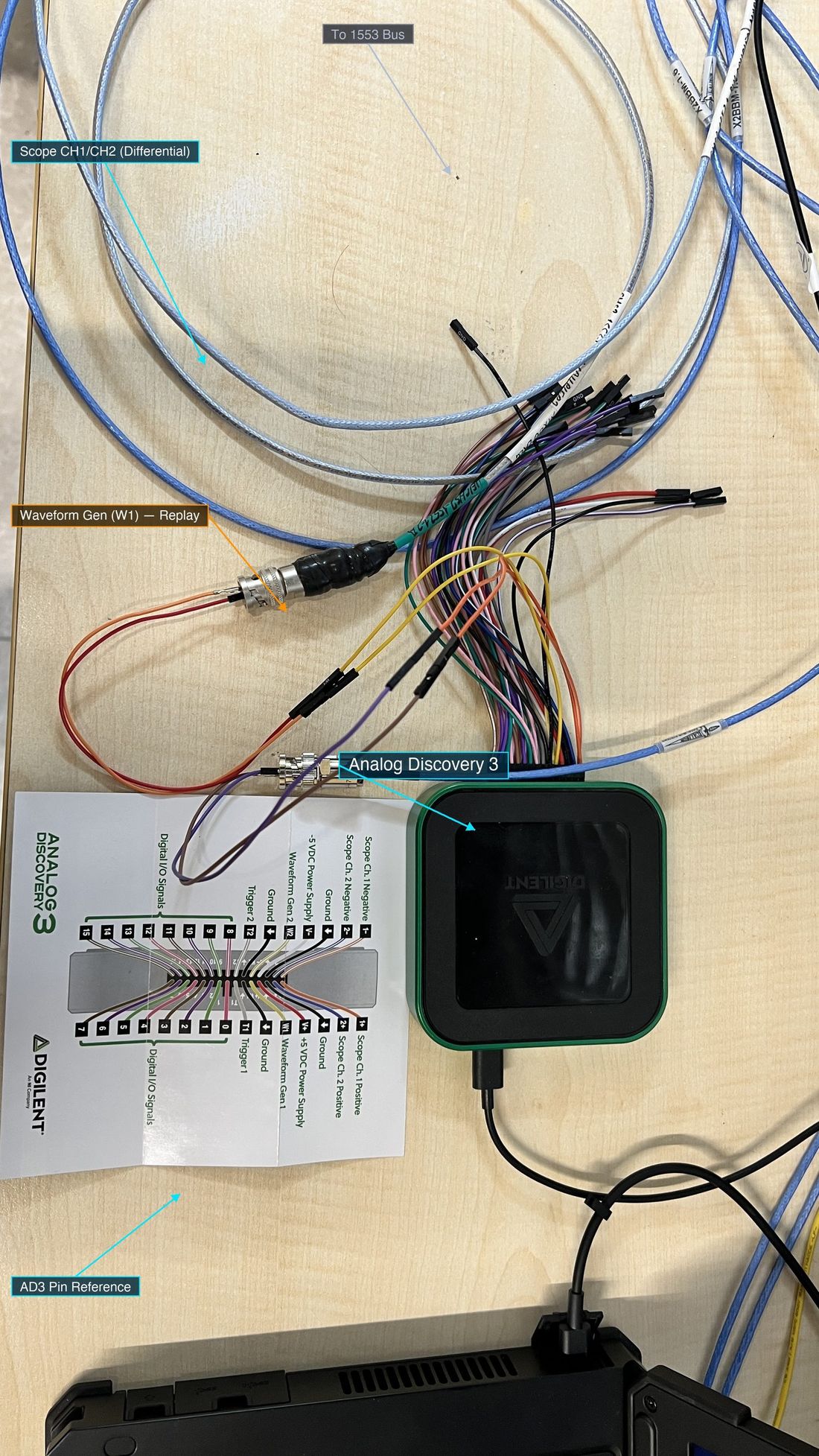
The WRAITH capture and replay chain. Independent equipment accepted every replayed signal.
04 / The Evidence
The recording walks back onto the bus
Captured waveforms from legitimate infrastructure, replayed through the
14-bit converter, evaluated by independent test equipment operating off the replay path.
Reported fingerprinting accuracy (foreign hardware) versus the WRAITH replay
Defense
Bus
Reported accuracy
vs. WRAITH
Evcil et al. · RF / KNN / SVM / CNN
MIL-STD-1553
100%
Bypassed
Evcil et al. · Local Outlier Factor
MIL-STD-1553
99.9%
Bypassed
ANoMili · CNN
MIL-STD-1553
99.45%
Bypassed
Reported accuracy is against a different physical device, the scenario
the original papers evaluate. “Bypassed”: the replay is the captured waveform re-emitted, so by
Proposition 1 a classifier reading the same voltage trace cannot separate it from the original.
17.2dBmean channel SNR, comfortably inside the AD3's 84.3 dB range. The bus, not the attacker's instrument, sets the fidelity ceiling, so the replay has ample headroom to land inside the noise the defender must already tolerate.
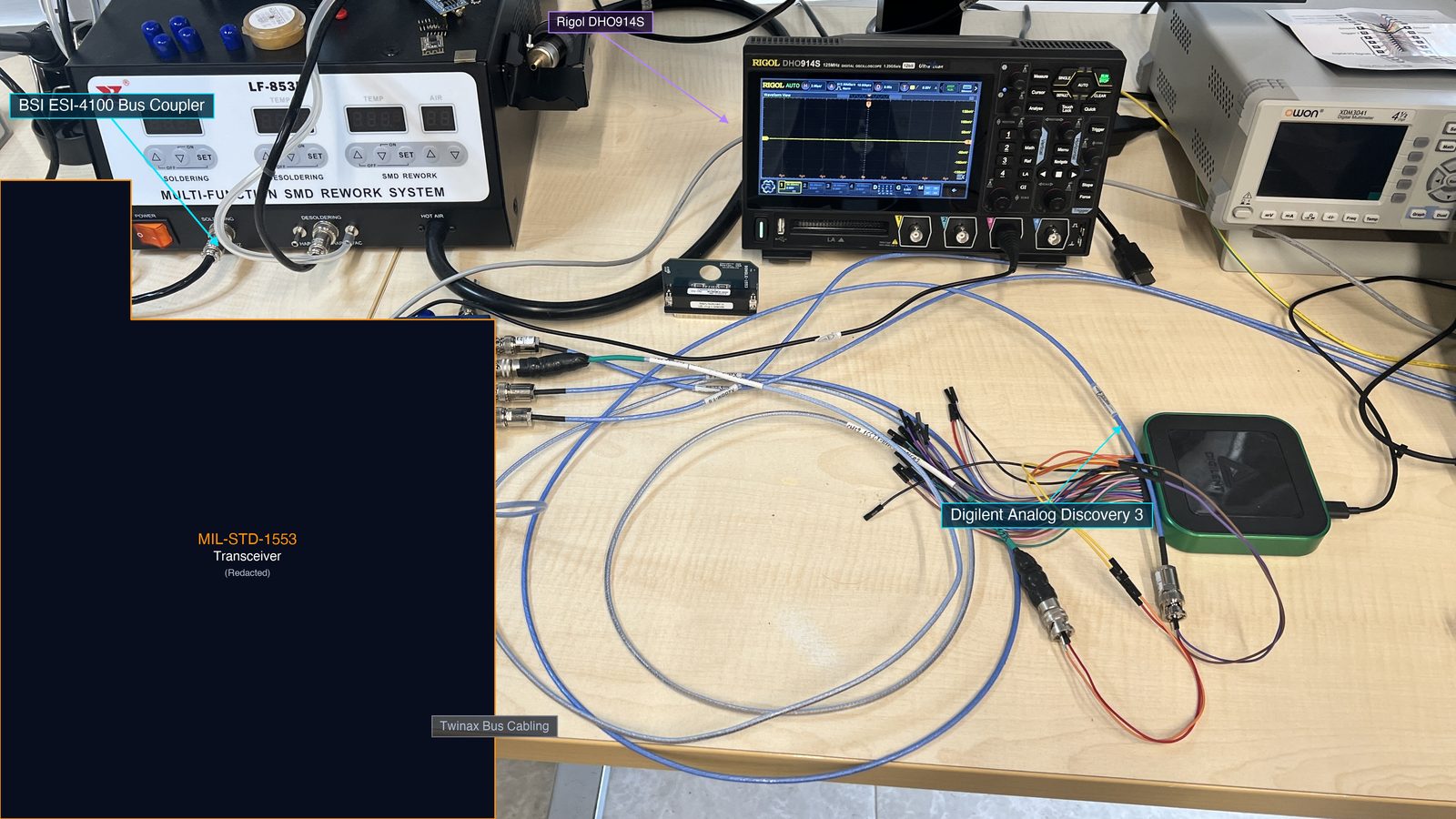
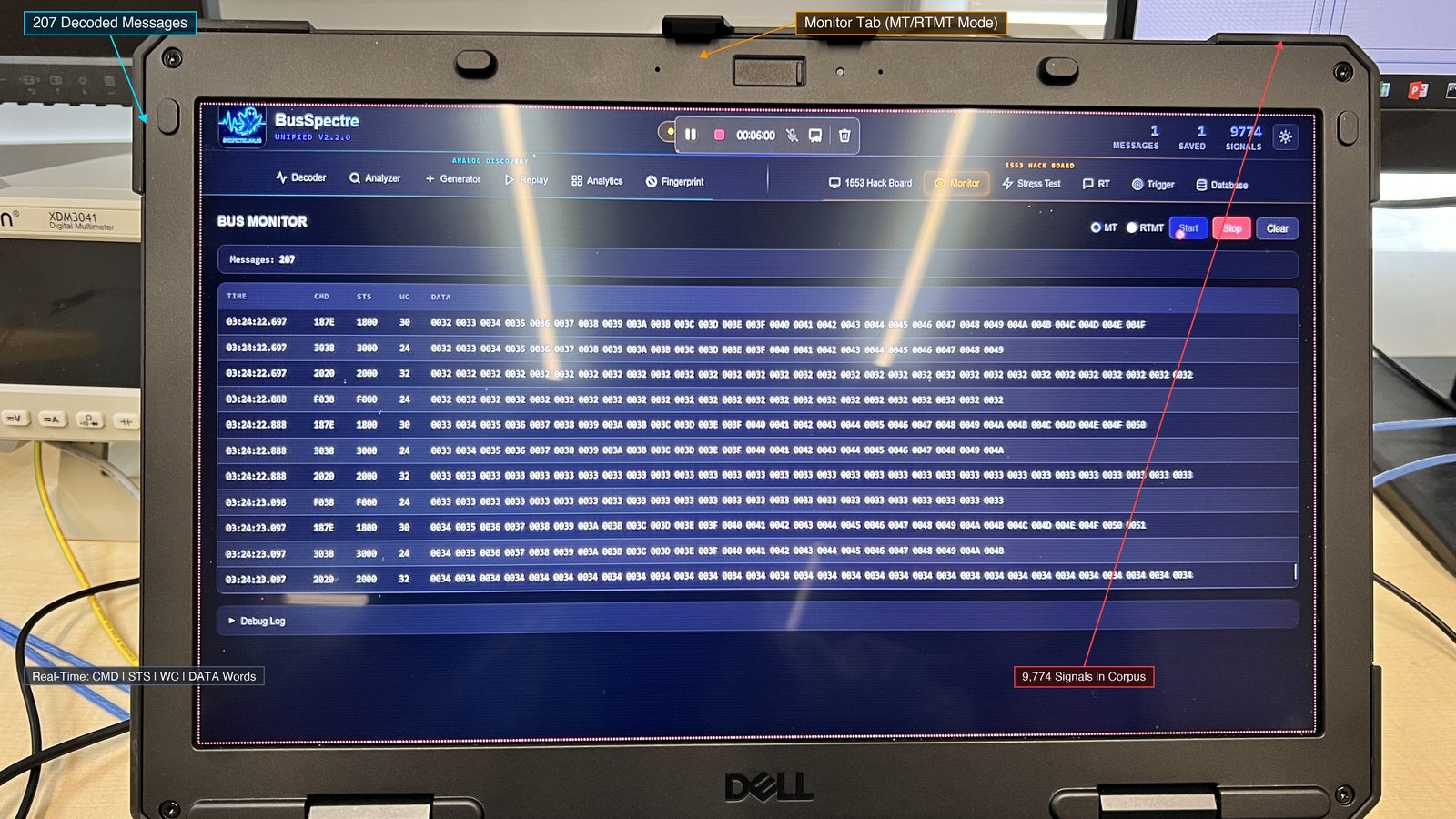
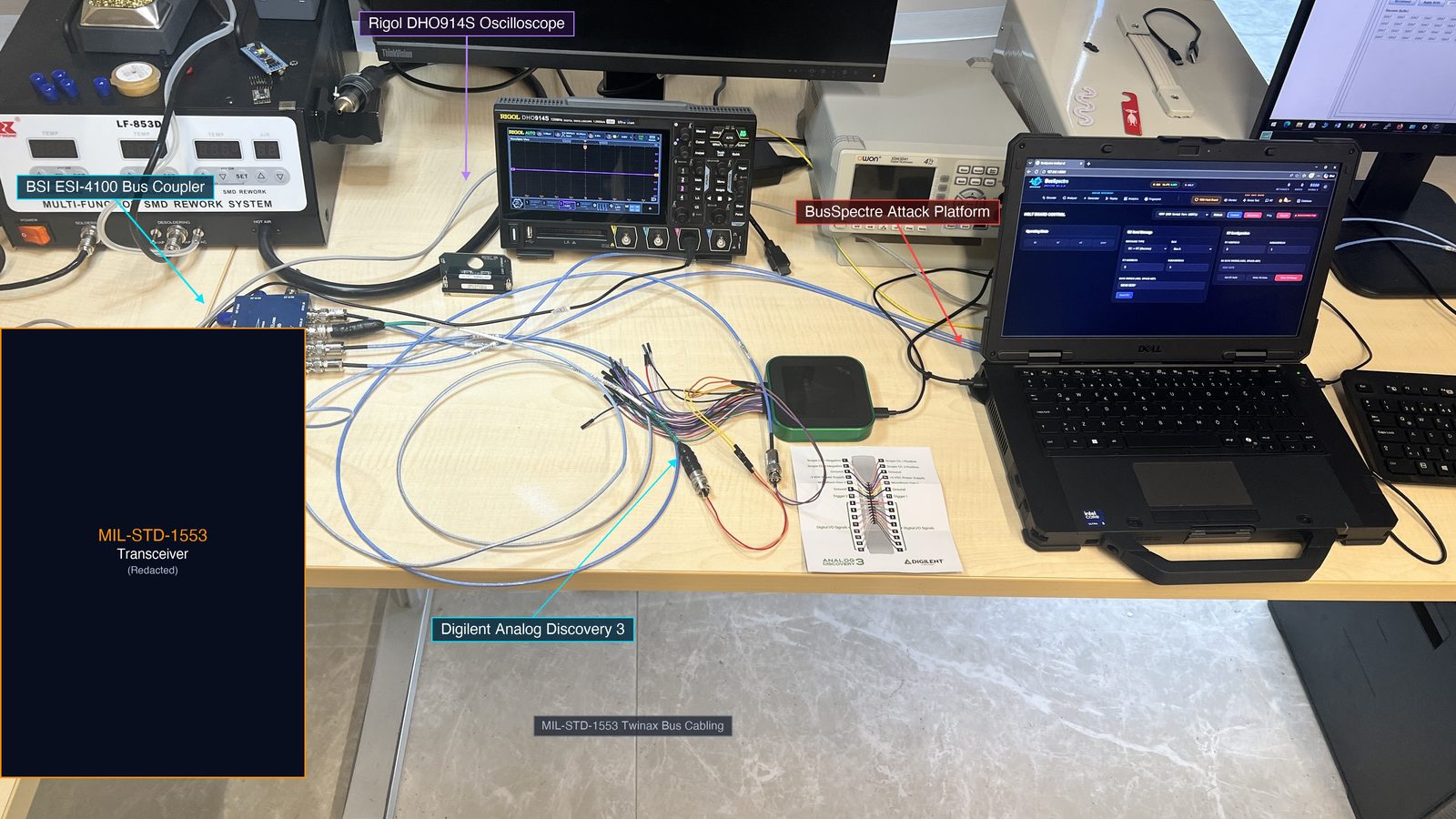
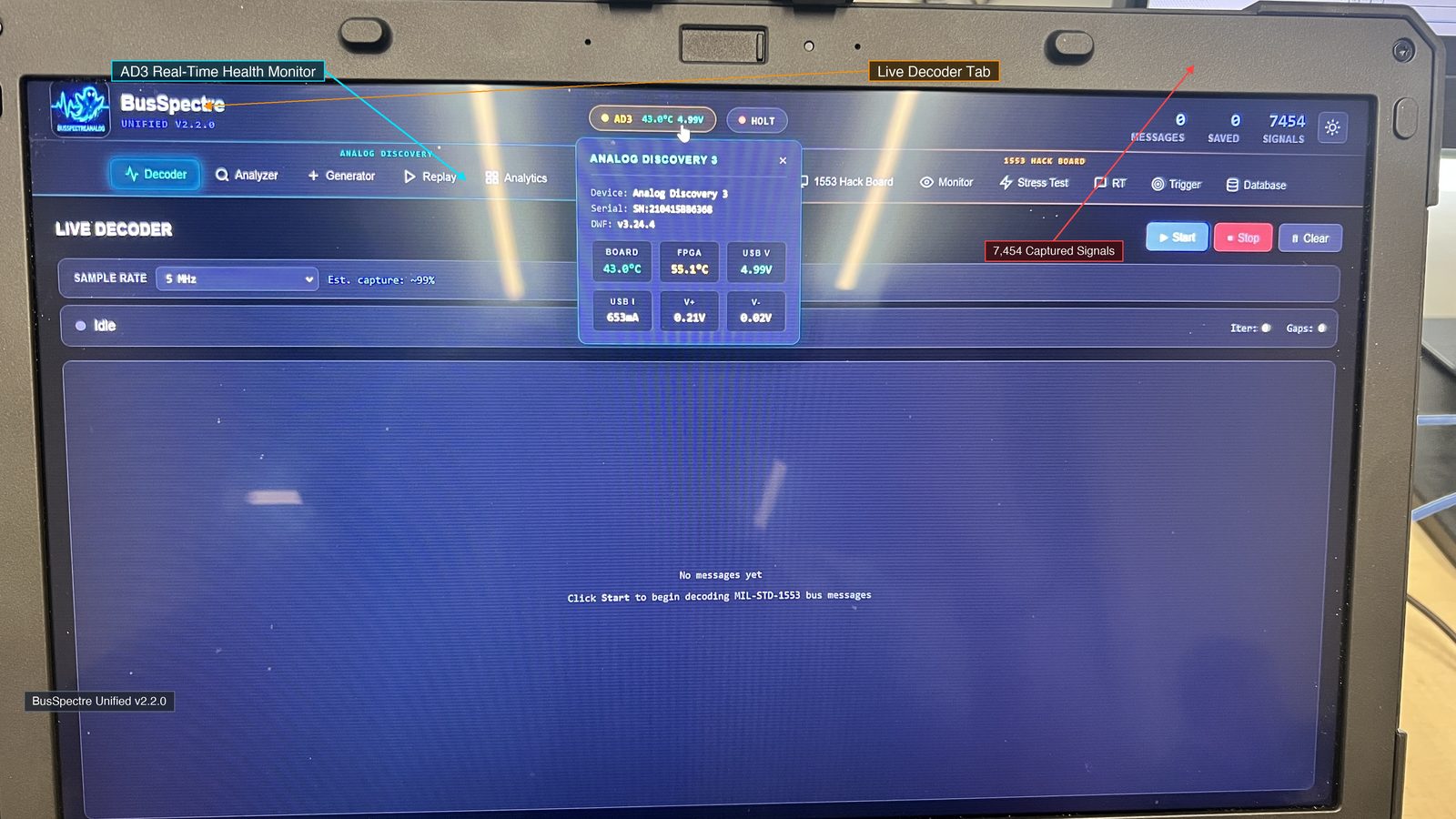
Live decode during capture. Every message is also stored as a raw voltage array, preserving the analog signature for replay.The isolated bench. One commodity device performs both capture and replay; a separate scope verifies.
The attack itself needs only one message. The figures below are from a single example capture and analysis run on BusSpectre, the session shown above, not a general benchmark.
11,349captured signals · 258 MB
7,442primary 1553 messages · 9 RT addresses
99.8% parity pass · 188,533 / 188,923 words
0.993median intra-device cosine similarity
05 / The Platform
BusSpectre
The whole attack platform, end to end: under $500 of commodity hardware, weaker
than the adversary prior fingerprinting work assumes, and the software that captures, analyzes,
and replays.
The kit · under $500, off the shelf
One commodity USB oscilloscope: differential capture in, 14-bit analog replay out.
The BusSpectre operator interface: live capture, real-time decode, device-health telemetry.
Single-handle DWF sessionMultiplexes capture, replay, and health monitoring on one commodity oscilloscope so they never collide on the USB endpoint.
ScanShift + Numba JITA continuous sliding-window Manchester decoder compiled to native code, sustaining decode rates far above the input data rate.
Dual persistenceEvery capture is stored twice: the raw analog waveform at full resolution, and the decoded protocol fields, indexed for search.
Replay & real-time MitMOperator-selected captures scaled to bus voltage and emitted through a single analog channel, with pattern-matched live override.
Stop treating a reproducible property as an identity
These buses can be defended, just not by anything the adversary can observe and
reproduce. Authentication must rest on a secret the adversary cannot pull off the wire.
Why the obvious partial measure fails
A plaintext sequence number does not stop WRAITH: the adversary writes the next expected
counter value into the forged message exactly as it writes any other data word. Freshness
has force only when the adversary cannot produce a valid authenticator for the new counter,
which returns the problem to a secret key.
Segmentation is not a general answer
Isolating transmitters onto separate sub-buses shrinks each shared medium, but not every
shared medium can be expected to be divided into sub-buses: hardware limitations and
optimization requirements often forbid it. Where the bus must stay shared, measurement
symmetry still holds, and the authenticator has to be a secret the wire never carries.
Keyed MAC, with freshness bound under the key
A message authentication code computed with a per-device key gives unforgeable proof of
origin that neither a recording nor a forgery can supply. Timing is not the obstacle:
lightweight MACs designed for microcontrollers, such as Chaskey and
Ascon (the NIST lightweight standard, SP 800-232), fit inside the
4–12 µs 1553 response window. A truncated 32-bit code fits in two data words and suffices
for most operational needs.
Defense robustness against WRAITH
Defense
vs. WRAITH
Voltage fingerprinting (Evcil, ANoMili)
Bypassed
Commercial voltage IDS (Sital BRM1553D-SnS)
Bypassed
Plaintext sequence number
Bypassed
Timing anomaly (MAIDENS)
Partial
Protocol anomaly / rule filtering
Partial
Keyed MAC with freshness (Chaskey / Ascon)
Effective
“Partial”: catches malformed or mistimed traffic, but accepts a voltage-faithful
replay timed to an expected slot. “Effective”: cannot be forged or replayed without the key,
regardless of waveform fidelity.
The preprint
Hardware Fingerprinting as an Untrustworthy Primitive for Device Authentication
The WRAITH Attack: a doctrine-first impossibility result, with MIL-STD-1553 as the proof vehicle.
Citation and arXiv identifier will be published here on posting. This preprint is a
working version; author attribution is finalized before submission.
Responsible disclosure & ethics
WRAITH is defensive research. All experiments were conducted on an isolated laboratory bench,
against test equipment we own and control. No operational, fielded, or third-party system was
targeted, and the design of the commodity 1553 board used for reconnaissance is withheld. We
publish this work to correct a false assurance: a control marketed as authentication does not
meet an authentication objective on a shared bus, and treating it as one displaces the crypto
that actually would.
Where the finding implicates a specific product or deployed system, we support coordinated
disclosure and will work with affected vendors ahead of full publication. The corrective is
unambiguous and constructive: migrate device authentication to a keyed MAC with freshness bound
under the key. Disclosure inquiries are handled via the
project repository.
The Team
Authors
The people behind WRAITH and the BusSpectre platform.